How is Tinnitus Measured? Talking Tinnitus with Dr. Sarah Matthews
Tinnitus, commonly known as ringing in the ears, affects 15% of the global adult population. That means millions of people worldwide are living with tinnitus.
The majority of people will experience tinnitus temporarily after a concert or loud noise exposure. For those with long-term tinnitus, it can be a mild background noise. For others, tinnitus is a persistent noise that can impact their quality of life.
But how do experts actually measure a subjective condition? And why is measuring tinnitus so important?
Dr. Sarah Matthews joins today’s How is Tinnitus Measured? episode of Talking Tinnitus to explore what tinnitus is, what causes it, how tinnitus measurement works.
Dr. Matthews also explains two of the most common measurements – Tinnitus Handicap Inventory (THI) and Tinnitus Functional Index (TFI) – and how they are used in clinical practice.
- 1. What is Tinnitus?
- 2. What Causes Tinnitus?
- 3. How is Tinnitus Measured?
- 4. Tinnitus Grades
- 5. THI and TFI?
- 6. Tinnitus Treatments That Work
- 7. Does Lenire Work to Treat Tinnitus?
- 8. Where Can I Get Help for Tinnitus?
- 9. Why is Measuring Tinnitus Worthwhile?
1. What is Tinnitus?
Tinnitus is the perception of sound without an external source. Tinnitus may present as ringing, buzzing, hissing, roaring, or even whooshing sounds. These are collectively known as tinnitus sounds.
These noises can vary in pitch, intensity, and duration, and can affect one ear (unilateral), or both ears (bilateral).
There are two main types of tinnitus:
- Subjective Tinnitus: Subjective tinnitus is the most common type of tinnitus and accounts for 99% of all cases. This type of tinnitus can only be heard by the person affected.
- Objective Tinnitus: This is a rare form of tinnitus. Objective tinnitus is caused by a physical issue. This kind of tinnitus can be heard and measured by a medical professional.
Regardless of the type of tinnitus, people describe tinnitus sounds as:
- Ringing in the ears
- Buzzing in the in the ears
- Humming in the ears
- Hissing in the ears
- Pulsing in the ears (pulsatile tinnitus)
- Whooshing in the ears
The impact of tinnitus can range from minor irritation to severe disruption of daily life, sleep, and emotional well-being.
2. What Causes Tinnitus?
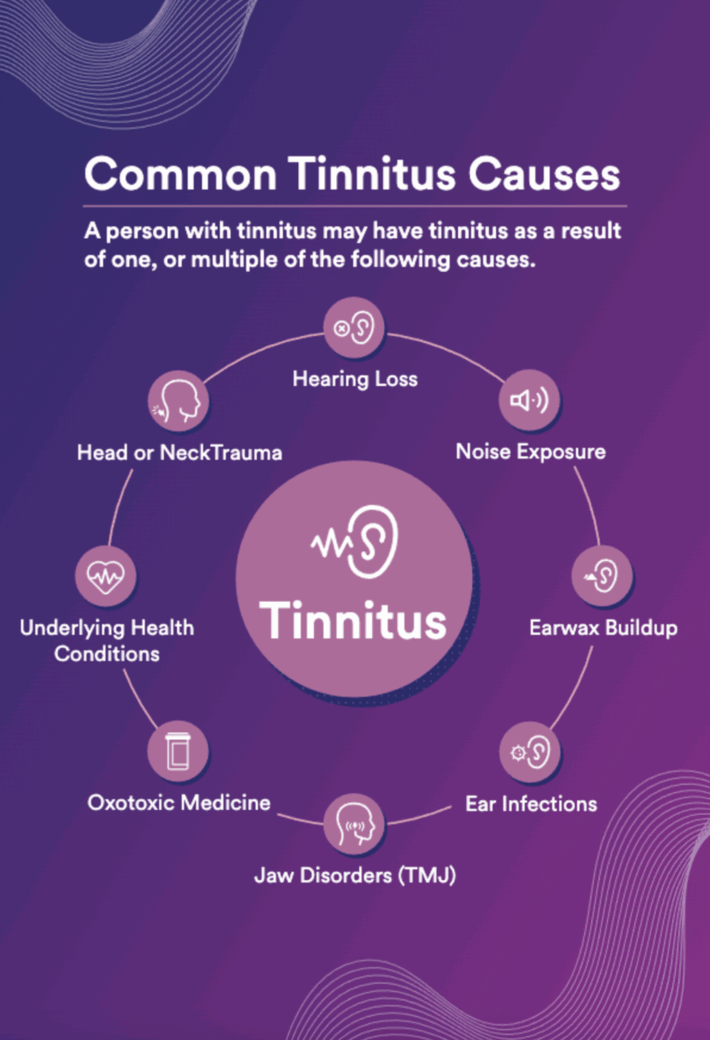
As there are many types of tinnitus, there is no singular cause of tinnitus. Common causes include:
- Hearing loss (age-related or noise-induced)
- Ear infections or blockages
- Head and neck injuries
- Ototoxic medications
- Circulatory disorders
Tinnitus is not always linked to a single cause — sometimes it’s part of a broader health picture. Stress can exacerbate tinnitus leading to tinnitus fluctuations.
3. How is Tinnitus Measured?
According to Dr. Sarah Matthews, Doctor of Audiology, “From a provider standpoint, tinnitus is measured using questionnaires that focus on different areas of life that may be affected by the tinnitus.”
These questionnaires aren’t about how “loud” the sound is, since tinnitus is subjective and can’t usually be heard by others. Instead, they measure impact on a person’s quality of life. These impacts include sleep, mood, concentration, and daily activities.
Two of the most widely used tools are:
- Tinnitus Handicap Inventory (THI) – A 25-question survey that identifies, quantifies and evaluates the difficulties a person experiences as a result of tinnitus. Scores range from 0 (no tinnitus) to 100 (catastrophic tinnitus).
- Tinnitus Functional Index (TFI) – Another validated measure of how tinnitus affects quality of life.
“These questionnaires,” Matthews explains, “give us a baseline especially since we know that tinnitus fluctuates. They’re very helpful to gather a snapshot over a person’s life for the last week.”
The measurements are repeated over time, initial assessment with follow-ups, so providers can track changes. Lowering your score over time generally means improvement, and, as Matthews notes, “We know how much change is actually statistically significant… enough that we can say it’s not just variation.”
4. How is Tinnitus Measured? Tinnitus Grades
Tinnitus is measured on a scale of 1 – 100 on the Tinnitus Handicap Inventory, for example. The higher your THI score, the more impactful tinnitus is on your life. These are classed in the following categories.
- 00 – 16: Grade 1 (Slight)
- 18 – 36: Grade 2 (Mild)
- 38 – 56: Grade 3 (Moderate)
- 58 – 76: Grade 4 (Severe)
- 78 – 100: Grade 5 (Catastrophic)
Lenire’s second clinical trial demonstrated that our dual mode approach could reduce tinnitus impact by a full grade. For example, reducing tinnitus from Severe to Moderate.
5. What is THI and TFI?
Tinnitus Handicap Inventory (THI) and the Tinnitus Functional Index (TFI) are both accepted methods of measuring tinnitus impact on someone’s life.
There are differences between TFI and THI.
Tinnitus Handicap Inventory (THI)
The THI is one of the most established and widely used questionnaires in tinnitus care. It contains 25 questions scored to produce a total between 0 (no impact) and 100 (severe impact).
According to Dr. Sarah Matthews:
“The Tinnitus Handicap Inventory has some subsections that focus on sleep [and] emotional reaction to the tinnitus so that it gives the individual and the provider an option of seeing what’s really going on here.”
You can take the Tinnitus Handicap Inventory questionnaire on the American Tinnitus Association’s website.
Key Benefits of the THI:
- Provides normative data to show if changes are statistically significant
- Long-term clinical use with strong international recognition
Tinnitus Functional Index (TFI)
The TFI is a newer, highly sensitive questionnaire designed to track changes over time especially during active treatment. It also includes 25 items, grouped into eight subscales such as relaxation, quality of life, and emotional distress.
THI vs. TFI: Comparison Table
THI and TFI are very similar with subtle differences in how they measure the impact tinnitus has on a person.
| Feature / Criteria | Tinnitus Handicap Inventory (THI) | Tinnitus Functional Index (TFI) |
| Purpose | Measures overall impact of tinnitus on a person’s quality of life. | Similar to THI with week-by-week recency monitoring and slightly different criteria. |
| Question Count | 25 | 25 |
| Scoring Range | 0 – 100 (higher = worse impact) | 0 – 100 (higher = worse impact) |
| Detailed Subscales | Yes | Yes |
| Best Use | Baseline tinnitus assessment and long-term change monitoring. | Detecting changes during treatment and research studies. |
| Change Sensitivity | High with clinician flexibility | High |
| International Recognition | Widely used in clinics worldwide | Emerging recognition |
| Backed by Tinnitus Real Patient Evidence | Yes | Yes |
Table sources include Research Gate, THI; Newman et al., 1996, NCBI, Lenire Clinical Trials, NovoPsych
6. Tinnitus Treatments That Work
While there is currently no cure for tinnitus, there are a range of tinnitus treatment options. These include:
- FDA-approved tinnitus treatments like bimodal neuromodulation devices
- Sound therapy to mask or retrain the brain’s perception of tinnitus
- Cognitive Behavioral Therapy (CBT) for emotional and psychological support. CBT is often paired with other tinnitus treatment methods.
- Hearing aids for those with hearing loss. Hearing aids also pair well with bimodal neuromodulation for tinnitus treatment.
- Lifestyle changes such as stress reduction and sleep improvement can give tinnitus relief.
Submitting a THI and TFI survey with an audiologist can help you understand your tinnitus baseline and track improvement.

7. Does Lenire Work to Treat Tinnitus
Lenire is an at-home bimodal neuromodulation tinnitus treatment device. It is the first and only FDA Approved tinnitus treatment device. Lenire is available exclusively through qualified tinnitus care providers in the United States of America and Europe.
The device works through stimulation of the auditory and somatosensory nerves. Proprietary audio plays via Bluetooth headphones to stimulate the auditory nerve combined with mild pulses to the surface of the tongue using a small intra-oral Tonguetip.
Lenire is used for two 30-minute sessions per day for a period of time recommended by their healthcare professionals. Patients are guided through the process by a tinnitus expert. Patients attend regular check-ins to benchmark their tinnitus impact as they use Lenire.
Neuromod, creators of Lenire, conducted a controlled clinical trial and included real world evidence as part of the device’s De Novo FDA Approval process. Both clinical trial and real world evidence supports Lenire as an effective tinnitus treatment.
- TENT-A1 Clinical Trial: 80% of patients reported a significant reduction in tinnitus severity that lasted at least 12 months. This clinical trial was the cover story in Science Translational Medicine.
- TENT‑A2 Clinical Trial: 91% of TENT-A2 participants had relief that sustained for at least 12-months. Nature – Scientific Reports peer-reviewed and published TENT-A2.
- TENT-A3 Controlled Tinnitus Clinical Trial: 70% of patients with moderate or worse tinnitus had clinically meaningful relief from tinnitus with Lenire. This is compared with negligible improvement from sound-therapy, the trial’s control. Nature Communications peer-reviewed and published TENT-A3.
- Peer Reviewed Real World Data: 91.5% of 220 patients reported significant relief from tinnitus. Nature Communications Medicine peer-reviewed and published this real world evidence.
Following an in-depth tinnitus assessment, you should ask your tinnitus care professional about clinically proven treatments such as Lenire.
8. Where Can I Get Help for Tinnitus?
If you’re experiencing ringing in the ears or other tinnitus sounds for longer than 48-hours, you should seek help. The best place to start is with a hearing care professional. Ideally one experienced in tinnitus management. They can:
- Conduct a tinnitus assessment that includes an audiological assessment and tinnitus measurement questionnaire(s)
- Explain your tinnitus in simple terms and offer reassurance
- Develop a personalized treatment plan
- Host ongoing check-ins to measure the impact of treatments.
Need more information? Go to authoritative sources such as the American Tinnitus Association or Tinnitus UK. These charitable organisations have the brightest minds in the tinnitus space who are ready to support you with helpful tinnitus resources.

9. Why Measuring Tinnitus Matters
Dr. Matthews compares setting a baseline for your tinnitus to stepping on a scale when trying to lose weight:
“We see that hard number and it reinforces that what you’re experiencing is true, and it is really heading in that direction of change we want to see.”
By regularly measuring tinnitus impact during tinnitus treatment, both patients and providers can confirm progress, adjust treatments, and focus on what works.
How is Tinnitus Measured? | Final Thoughts
Tinnitus may be subjective, but assessment tools such as the THI and TFI can help a professional measure, track and manage tinnitus effectively.
As with every episode of Talking Tinnitus, If you are living with tinnitus, book at tinnitus assessment with an expert tinnitus clinic. You can find a clinic near you by visiting Lenire’s Find a Clinic Map.